Berlin Work Trip

This week I went on a quick little trip to Berlin, for a 2-day conference/learning event.

It was really interesting, and I was able to catch up with lots of ex-colleagues who have moved on to other agencies, and I haven’t seen in a while.

Basically, the conference was interesting, I learnt a lot, and I got to hang out with some really awesome people, including one old friend who I haven’t seen for years, and who I had no idea would be there, which was a lovely surprise!

Sadly I flew in on Tuesday night, and flew out on Thursday night, so had EXTREMELY limited time to hang out in funky groovy Berlin, but here’s a very tiny taste of what little I did manage to do!

Firstly, at the train station, there was this. In the UK, these type of industrial water towers are concrete and graffiti – but in Berlin they are COOL.

Continue reading

Reality Check…

Well, I have had my official Stage 1 meeting (in December), and I have been given a long list of homework to do in the next 2 months, including:

  • Read at least 3 books from the reading list
  • Complete a family tree
  • Create a chronology of my life (including every address I have ever lived at….)
  • Fill in the DBS forms for a criminal records/background check
  • Complete some e-learning courses
  • Create an Ecomap of my support network
  • Complete a household safety checklist
  • Obtain criminal records checks from any country I have lived in for over 6 months (THAT could take a while…)
  • Get 3 references
  • Have a full medical

The more reading and e-learning I am doing, the more I am starting to more deeply reflect on the process, what is involved, and the impact of adoption is starting to sink in.

It’s almost like they’ve done this before. (No seriously, I must say well done to the Local Authority for such a well-planned process so far, and it really feels like it is all very logical and well-thought out etc).

What is interesting is that starting out on this adventure, it was really, frankly, all about me. I want a family, I want a child/children, I want to adopt siblings, I’m busy fantasising about how lovely it will be, and whether or not they will be white, black, Asian or mixed race etc. Continue reading

The daily struggles of a non-technophile

I’m trying it hard to find a suitable word to describe myself these days. In the past I have considered myself a luddite, or techno-phobe, but in fact I have realised I embrace quite a lot of technology and systems, and therefore am quite willing to engage with lots of new things, (and have accidentally developed 8 or 9 e-learning courses and learning platforms) however I wouldn’t say that I love technology, and I’m often quite overwhelmed and intimidated by complex technology.

So I don’t know what word best describes me – feel free to suggest some new words I could try out!

This brings me to my latest problems….

Last year when my boiler died, I bought a Nest, which is a smart thermostat type of device. In theory, they will “learn” your habits, predict your heating needs, and save you money and energy, saving the planet and reducing your bills, etcetera.

Except after nearly a year of using it, I am forced to concede that this is utter bullshit.

Continue reading

The Horror

Sometimes, my job is incredibly uplifting and brilliant and I love it. Like the time in the Philippines when every single person in the village wanted to thank me and shake my hand, leaving my hand literally rubbed raw with good wishes from about 600 people…. Or the time I met a young mother with the best smile in the world after she received a cash transfer to help fix her roof.

But sometimes, being an aid worker is hard. Not just gruelling, tiring, exhausting and difficult. Not just because sometimes you’re in a war zone and there’s no electricity and it’s 46 degrees, and you’re sweating so much you wake up three or four times in the night because you’re so thirsty.

No, the hardest part for me is the emotional trauma. Sometimes in this job, even when you are safe in your bubble at headquarters, you hear stories that you cannot unhear, and they haunt you for days. As a naturally empathetic person myself, it’s hard not to be affected sometimes by the brutal tales coming from war zones, conflict and remote areas, and to feel quite deeply affected by those stories. What’s more challenging is that I can’t easily talk about these things with my friends and family, because if these things keep me lying awake at night, I don’t want to bring that kind of horror into the minds of my closest friends or relatives. Not to mention the fact that when visiting friends and family for a fun Christmas holiday, or a rare night out on the town, it’s almost never an appropriate time to start talking about the horrors of war and rape. It’s a massive downer and will almost always spoil the mood and make people uncomfortable.

Now don’t worry or panic here, let me reassure you that we have access to counselling and mental health support at work, so it’s not like there is no one to talk to, and many of my colleagues are good friends that I can talk to, so this blog post is not a desperate cry for help or any such thing. Sometimes I just find it helpful to write things down as a way of processing them. So instead of laying it onto the shoulders of my friends and family, I’m going to put some of the worst and saddest stories I’ve heard recently down here, in my blog, as a cathartic way of talking about them. So think carefully about whether or not you want to read the rest of this post.

Be warned – there are some pretty graphic and awful things in this post, so I will leave it up to you if you want to read on or not. Those of you who decide to read the rest of this post, you might want to have some fun, light-hearted kitten videos lined up on Youtube to cheer you up afterwards…. Continue reading

Localisation and the Capacity Building Conundrum…

So I’m starting out on my new job, and slowly re-entering the world of NGOs and Humanitarian Aid (my last job was slightly removed from the direct aid delivery itself and more at a consortia level).

One of the core pillars of my career to date has been capacity building, which I’ve been working on for a few years now, alongside various other things, and which draws from my previous career as a teacher as well as other roles I’ve had here and there. I had an interesting chat with a colleague recently which left me doing some reflecting on the whole concept…

First of all, there is great controversy over what capacity building is – some people think of it as just training, or learning more broadly, others think it incorporates knowledge management and research, skills-building and a range of other things. Another colleague informed me recently that “there is no such thing as capacity building – you can only develop a person’s existing capacity, you cannot build it, therefore there is no such thing as capacity building, only capacity development”.

Which is a bummer as my new job title involves the word “capacity builder”    🙂 Continue reading

2017 Book Challenge

This year, one of my new year’s resolutions was to read more books, so my Dad and I have decided to do this reading challenge together to get some new reading inspiration!

The list itself is fun, and we’ve both put together a list of books we plan to read in 2017. I’m going to post here all the books I have read (which I’ll update as I go along) with a short review of each book.

My first stop was a trip to Waterstones to buy some new books, as frankly, any New Year’s Resolution that involves shopping is a great idea! Continue reading

An Ode to my MacPac…

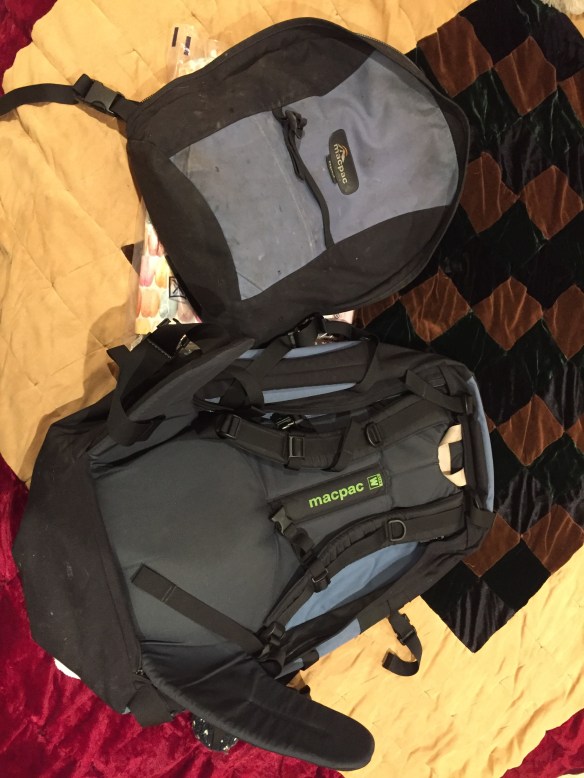
As I was recently rooting around in my loft for something, I found my big macpac, and realised I’ve had it for 10 years this year. It’s the best rucksack I’ve ever bought, it has a lifetime guarantee, and it’s EXTREMELY well-made, so I thought it was worthy of a little shout-out.

I bought my matching big and little macpacs in 2007, before going to Nepal for a year.

My big macpac has gone with me to Nepal, India, Malaysia, Singapore, France, Liverpool, South Sudan, India again, Nepal again, Kashmir, Oxford, the USA, The Philippines, Thailand, Australia, Iraq, Jordan, Canada, USA again, Australia again, Senegal, Kenya, Iraq again, and Senegal again.

Other than an unfortunate incident once where my Big Mac got ripped in an airport and needed to be patched (I sent it off to macpac and they fixed it up and shipped it back to me), it has held up remarkably well! In Nepal I used to keep it empty under my bed, but padlocked as my passport was in there, and when I lost the key, I had to beg the locksmith to cut through the padlock carefully not to damage the zip!

It’s incredibly comfortable, exactly the right size, and I love that it unzips like a proper suitcase instead of rooting around in a normal rucksack. I also love that you can fold in and zip up the straps when checking it in at airports so they don’t get damaged en-route.
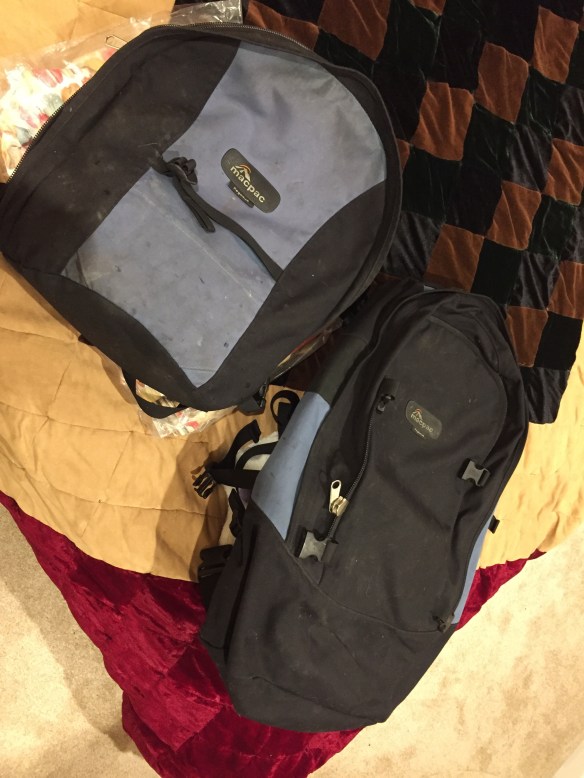
My little macpac has gone with me EVERYWHERE in the last 10 years. It’s literally my everyday bag, it carries my laptop into work everyday, it goes with me on mini-breaks and weekends, and in addition to all of the countries my big mac has been to it has ALSO been with me to Qatar, Madrid, Italy and Switzerland!

Obviously daily use for 10 years has left my little mac a bit grubby, but considering what it’s been through, it’s holding up INCREDIBLY well! It’s even still mostly waterproof, as I learned after a can of tonic water exploded inside it once in the Philippines…

This little bag goes with me pretty much everywhere, is still sturdy and comfy after 10 years, and it zips onto the front of Big Mac (although I hardly ever do that).

So, all in all, as a fairly frequent traveller, I give these bags 10 out of 10 and highly recommend them for your travelling adventures.

🙂
The stage before the stage before the 1st Stage…

So, as many of you will have read about in my first adoption post (Day 1….), I have officially started my journey to becoming a parent, and yes, I plan to document it all here for you, my lovely readers.

I have initially thought that there was a 3-step process, based on my research. The first stage takes about 2 months, and involves some initial interviews, a bit of basic training, and criminal records checks etc. Then the second stage, the home study, takes around 6-8 months and involves extensively poking around into every conceivable part of my life to look for holes or skeletons, talking to my friends, neighbours, employers, bank, mortgage lenders, etc. Then if you make it past that stage, you are “approved for matching” – and matching is the 3rd stage, where you and social workers try to match up approved adopters with children needing families.

So having spoken to the adoption team on the phone, attending an information day, and doing lots of reading, I assumed that my initial interview was the official start of Stage 1.

Turns out, it wasn’t. Continue reading